
An agent harness for ambitious work.
Why Sandwalk exists
Sandwalk exists to eliminate repetitive work—freeing human minds and teams to focus on ambitious questions that take days or months, not a single prompt—so individual curiosity compounds into collective discovery.
Serious research and engineering cannot live inside one vendor's model, one set of tools, or behind a subscription wall. Sandwalk is built for maximum freedom of where and how you work:
- Run anywhere: on your laptop, an always-on Mac mini at home, a Linux workstation, an HPC cluster, a cloud VM, or from your phone on the go.
- No subscription walls or lock-in: the entire harness—multi-agent grids, Capy, Specialists, Memory, Living Wiki, Omnigraph, and Benchmarking—is open, self-hosted, and Apache-2.0. You bring your own keys, your existing ChatGPT plan, or your own hardware.
- Switch effortlessly between cloud and local: move between 17 cloud providers, ChatGPT Plus/Pro, local GGUF models (
llama.cpp, Ollama, oMLX, LM Studio), or any OpenAI-compatible endpoint—and between local execution and on-demand Modal cloud GPUs—within the same session. - Share what you discover: the work stays on the machine that ran it, and a crystallized skill (
SKILL.md) or a published page (sandwalk.site) is how a verified method or result is passed on to the next person or agent.
Core Architecture
| Pillar | What you get |
|---|---|
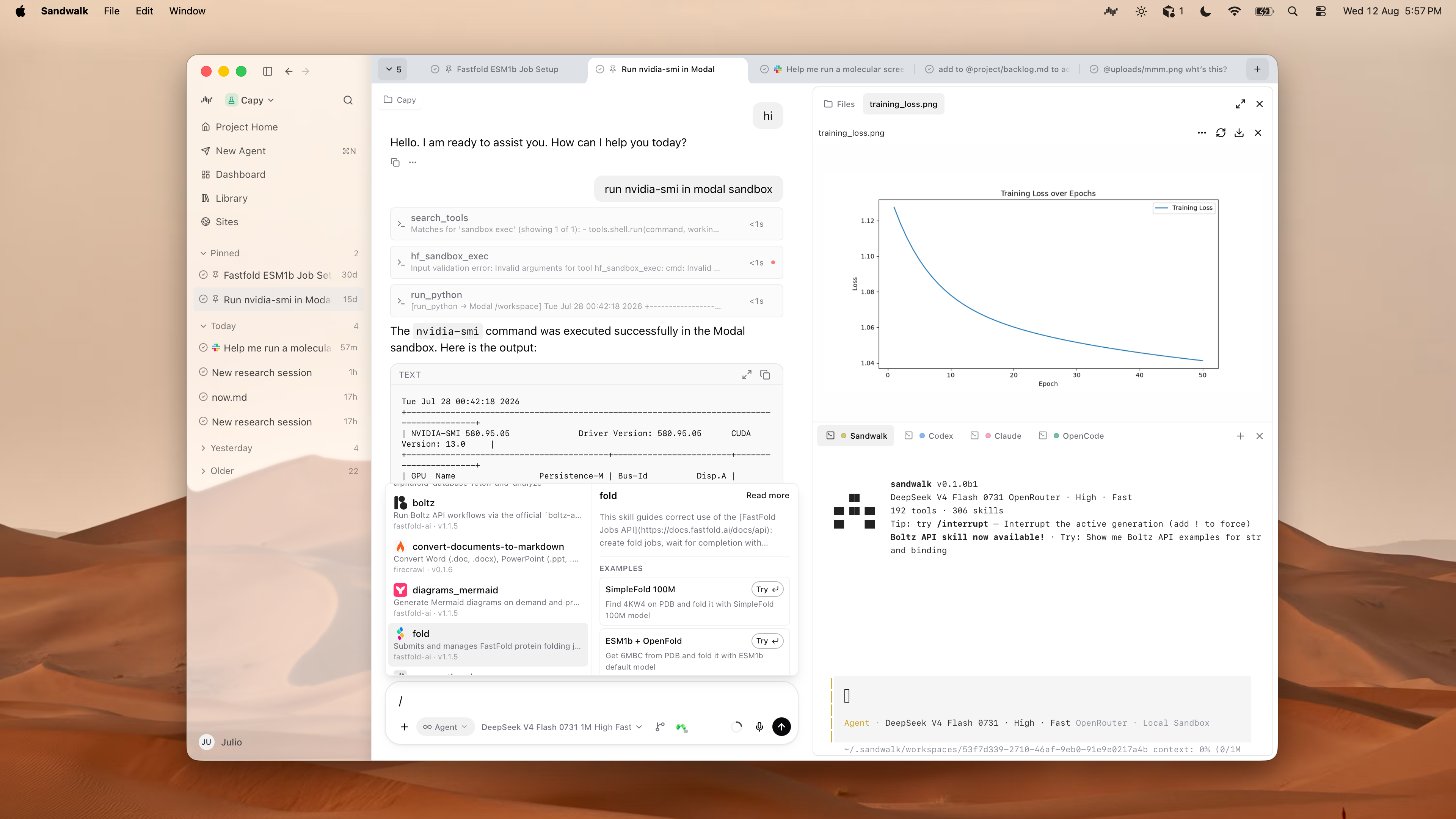
| One Workspace Everywhere | Shared session list across the macOS/Ubuntu desktop app, Web UI, terminal CLI (sandwalk), LAN/phone, and external coding CLIs (Claude Code, Codex, OpenCode, fx, Hermes). |
| Any Model, Cloud or Local | 17 cloud providers (OpenAI, Anthropic, Gemini, xAI, DeepSeek, OpenRouter, Bedrock, etc.), Sign in with ChatGPT (Plus/Pro), local GGUF models via llama.cpp, Ollama, oMLX, and LM Studio, or any OpenAI-compatible endpoint (vLLM, SGLang, TGI, LiteLLM, custom HPC servers). |
| Capy & Multi-Agent Grids | Built-in meta-agent (Capy) that spawns parallel sessions, arranges split grids, seeds briefs across chats, manages memory/wiki/graph, and runs diagnostics or benchmarks by voice or text. |
| Customizable Specialists | Starter personas (Otium, Atlas, Nova, Milo, Soren) and scientific specialists—or create your own (+ New specialist) with custom priors (PRIORS.md), model, skills, MCPs, and brain. |
| Memory, Wiki & Omnigraph | Automatic post-run distillation into bounded USER.md/MEMORY.md snapshots, a full-screen Markdown Wiki with live preview & [[wikilinks]], and a Lance-backed .omni Knowledge Graph with 6 Cookbook Modes (01–06). |
| Automations & Remote-SSH | Schedule recurring or event-driven agent workflows (sandwalk cron / Automations) and connect to remote Linux, macOS, or GPU servers over SSH (sandwalk ssh / SSH) with automatic user-space installation and 24/7 background daemons. |
| Skills & 1-Click MCPs | Install public skills from skills.sh (including NVIDIA's /tao-run-on-slurm), attach 1-click MCP servers, or crystallize your own project's Memory, Wiki, and Ontology into a reusable /skill. |
| Local & Cloud GPU Sandboxes | Execute code locally or on Modal CPU/GPU containers (T4, L4, A10, A100, H100). Every plot, 3D molecular structure, report, or .ipynb notebook lands beside the session, ready to publish to sandwalk.site. |
| Scientific & Harness Evals | 190+ built-in tools (PubChem, ChEMBL, UniProt, PDB, Open Targets, ClinicalTrials.gov, DepMap, MSigDB, STRING) plus end-to-end harness benchmarking (sandwalk eval) across MMLU-Pro, LiveCodeBench, BixBench, and Bio-Capybara. |
Explore the Docs
Quick Start
Install on macOS or Ubuntu and start your first session in minutes.
App & Composer
Desktop app, Composer, Plan mode, Capy split grids, Library, 3D artifacts, and embedded terminals.
Specialists
Starter personas (Otium, Soren, Milo, Nova, Atlas), scientific profiles, and + New specialist.
Memory, Wiki & Omnigraph
Bounded snapshots, Full-Screen Markdown Wiki, 6 Omnigraph Cookbooks, and Skill crystallization.
Automations
Schedule recurring or event-driven agent workflows, thread snoozing, and webhook triggers.
SSH & Remote Servers
Connect to remote servers over SSH with 1-click user-space auto-install and 24/7 background daemons.
Models (Cloud & Local)
17 cloud providers, ChatGPT Plus/Pro sign-in, local GGUF, and OpenAI-compatible endpoints.
Benchmarking & Evals
Evaluate models, Specialists, skills, and sandboxes end-to-end.
Last updated on